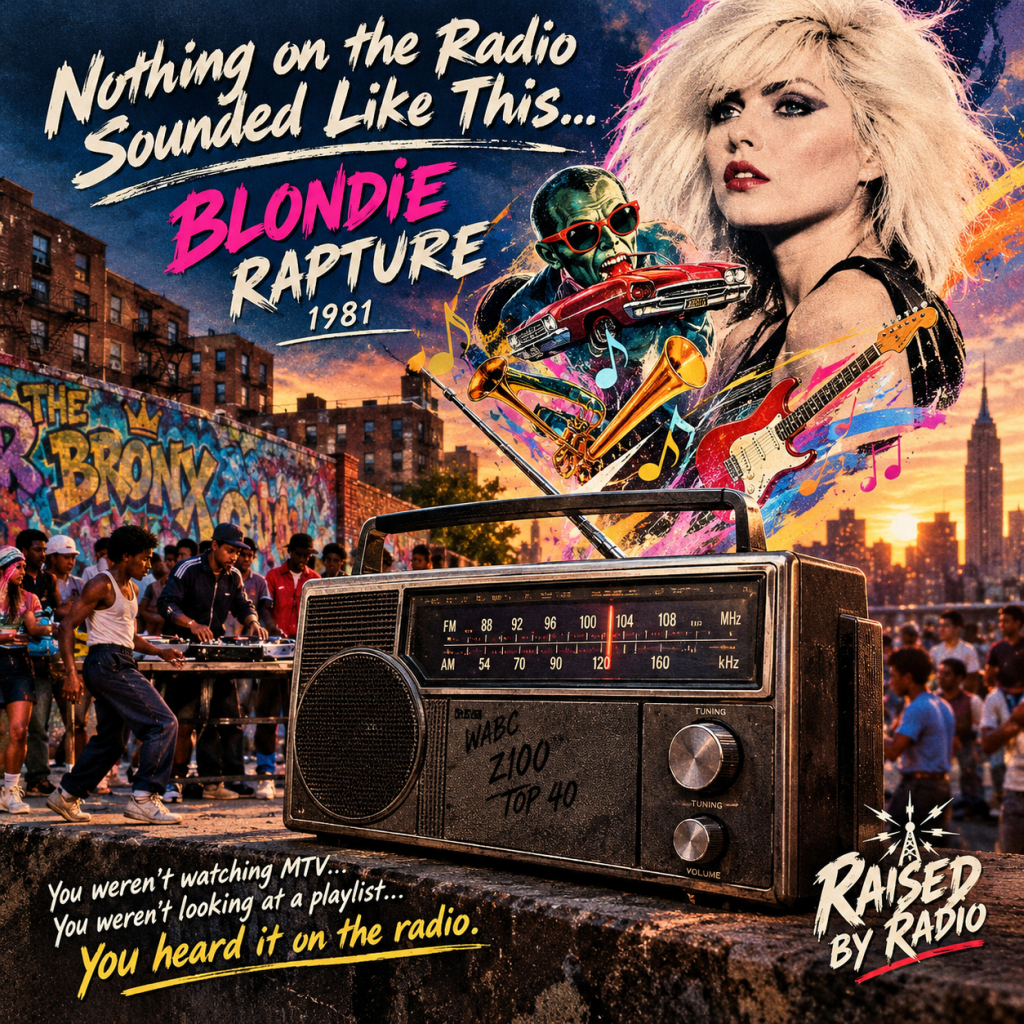
Nothing on the Radio Sounded Like This:
Blondie — “Rapture” (1981)
There are certain songs you hear on the radio and immediately know:
Nothing else sounds like this.
For me, Blondie’s “Rapture” is one of those songs.
I first heard it on the radio in 1981, growing up in the South Bronx. And that detail matters, because while “Rapture” was being played all over the country, I was hearing it from a place where the sound that Blondie was borrowing from wasn’t some brand-new curiosity.
Rap music was already part of the neighborhood.
Hip-hop was being born in the Bronx. DJs were breaking records apart, MCs were rhyming over beats, block parties were becoming laboratories for a completely new kind of music.
So when “Rapture” came along, I understood what I was hearing.
I also understood why some people were—and still are—uncomfortable with the way history sometimes remembers the song.
“Rapture” became the first rap song to reach #1 on the Billboard Hot 100.
And that statement can be complicated.
Because rap didn’t begin with Blondie.
It didn’t begin with Debbie Harry.
It didn’t begin on Top 40 radio.
The culture had already been developing in the Bronx, in Black and Latino communities, long before the mainstream music industry knew what to do with it.
So, yes, I completely understand the frustration when “Rapture” gets presented as though Blondie somehow invented rap.
They didn’t.
But here’s the thing:
None of that changes how much I absolutely love this song.
Because forget the historical footnotes for a moment.
Just listen to it.
What in the world was this?!
😂
It starts with that funky, almost hypnotic groove.
Then come those horns.
Then that guitar.
And then Debbie Harry starts singing about an extraterrestrial who is going to—
“Eat cars.”
Wait.
What?
And then:
“Man from Mars eat cars, bars, and then eat guitars…”
This was not exactly Shakespeare.
It didn’t have to be.
That was part of the fun.
Rap was still young enough that rhyme could simply be about rhyming.
You could string words together because they sounded good together. You could make a ridiculous statement because it sounded cool. You could create a rhythm and a cadence and just have fun with it.
And “Rapture” absolutely did that.
Then Debbie starts rapping.
And for a kid in the Bronx hearing this on the radio, there was something almost surreal about it.
Because suddenly, the sound of the neighborhood was coming through everybody’s radio.
Not just the radio stations in New York.
Not just the clubs.
Not just the Black stations.
Everywhere.
And that was a big deal.
“Rapture” crossed boundaries.
You could hear it at a club.
You could hear it on a Black radio station.
You could hear it on pop radio.
You could hear it coming out of somebody’s car.
And you could hear it on the same radio that was playing Hall & Oates, REO Speedwagon, Journey, Foreigner and whatever else happened to be dominating the Top 40 that week.
And somehow…
it fit.
Well, maybe it didn’t fit.
Maybe that’s precisely why it was so great.
Because musically, “Rapture” was a beautiful mess of things that shouldn’t have necessarily gone together.
The horns.
The funky rhythm.
The electronic sounds.
The guitar.
Debbie Harry’s vocals.
The rap.
And then, after the rap, that killer guitar solo.
That guitar solo almost feels like the song saying:
“Oh, you thought we were finished?”
NOPE.
Here’s some rock ‘n’ roll.
And then the song keeps going.
It was impossible to categorize.
Was it rock?
Pop?
New wave?
Funk?
Disco?
Rap?
Yes.
All of it.
And maybe that’s why it sounded so different.
This was the early 1980s, when radio was still this incredible musical melting pot. You could turn the dial and hear completely different worlds.
And then along came “Rapture.”
It didn’t ask permission.
It just showed up.
And somehow this strange, funky, futuristic, completely unexpected song became a massive hit.
And I think that’s one of the things I loved most about radio growing up.
You never knew what was coming next.
You could be sitting there listening to your favorite station and suddenly hear something you’d never heard before.
Something that made you stop what you were doing.
Something that made you say:
“What IS this?”
“Rapture” did that.
And yes, history should absolutely recognize where rap music came from.
It should recognize the Bronx.
It should recognize the Black and Latino artists and DJs and MCs who built hip-hop from the ground up.
But history can also acknowledge what “Rapture” represented.
It was one of those moments when something happening in the streets finally broke through into mainstream America.
And for me, personally, there was something pretty cool about hearing it happen.
Because I wasn’t hearing the Bronx being introduced to the world.
I was hearing something from my world make its way onto the radio.
And that’s why, controversy and historical arguments aside, I’ll always have a soft spot for this song.
Because when “Rapture” came on the radio in 1981, it didn’t sound like anything else.
The horns didn’t sound like anything else.
The beat didn’t sound like anything else.
The rap didn’t sound like anything else.
The guitar didn’t sound like anything else.
And a man from Mars was eating cars, bars and guitars.
It made absolutely no sense.
And it was fantastic.
That, to me, is what great radio was all about.
You didn’t always have to understand it.
You just had to hear it…
and think:
“Whoa. What the heck was THAT?”
And then turn the volume up.
Because sometimes…
nothing on the radio sounded like this.


Leave a Reply